USPTO Open Data Initiative
In the summer of 2015 – my first large project after joining CGI – USPTO tasked me with leading the design vision for a federal mandate: make the agency's “treasure trove” of patent and trademark data open, machine-readable, and usable by the public. I spent three months defining the product vision and information architecture with senior USPTO stakeholders ahead of development that September, then kept running weekly JAD sessions and supporting the project through its release the following summer.
Product design lead
Product vision & IA for USPTO's public open data platform
USPTO executive leadership; Director Michelle K. Lee's (opens in a new tab)office
Shipped ahead of schedule; ran ~8 years before evolving into USPTO's current platform
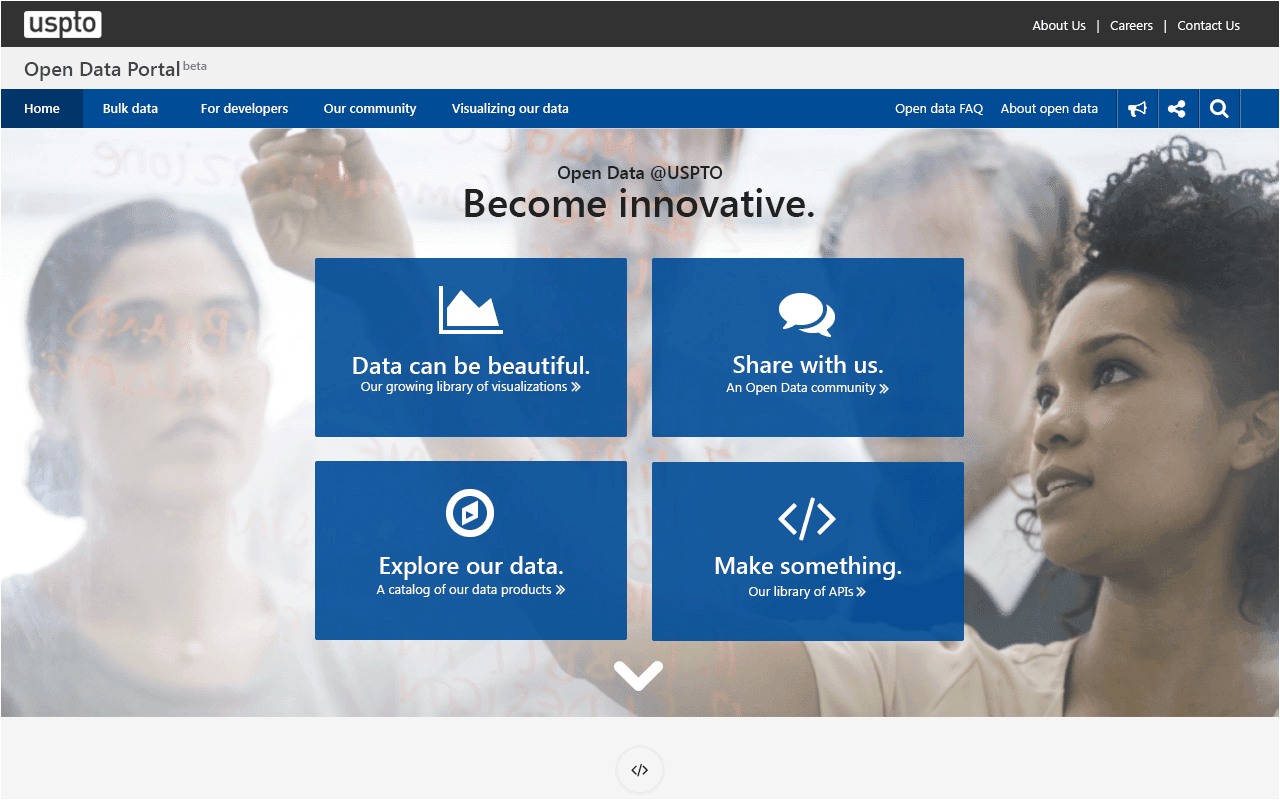
Home page for the Open Data Portal (beta public release)
WHERE IT STARTED
USPTO had a mandate from the White House: all patent and trademark data must be made available to the public by August of 2016.
In 2013, Executive Order 13642 changed the default posture of the federal government: agency data would be open unless there was a specific reason to withhold it. For USPTO – an agency whose entire mission is built on disclosure in exchange for exclusive rights – that mandate landed somewhere it already made philosophical sense: the agency had long treated itself as responsible for sharing what it held.
I was brought in in June 2015 – before scope, before a dev team, before even a firm sense of what "done" looked like. My job was to build that picture with the people who'd be accountable for it.
For three months, I worked daily with USPTO's senior stakeholders, out of a war room where our team reported directly to then-USPTO Director Michelle Lee, to define the product vision and information architecture ahead of development kicking off that September.
The process began with the product vision.
With the foundation set, I kept running weekly JAD sessions and stayed on through the site's release the following summer – refining scope, working through open questions, and keeping the vision coherent as development moved forward, even as I took on other CGI and USPTO work alongside it. I presented the evolving picture to USPTO's executive leadership every two weeks.
Design owned the product vision on this project, not just the interface.
Home page concept from the Product Vision.
During the first three months of the project, I was able to sit with stakeholders to get a sense of what they needed. The Product Vision was fully established before development – this allowed us to easily communicate the site concept to senior leadership and scope the Product Backlog for the dev team.
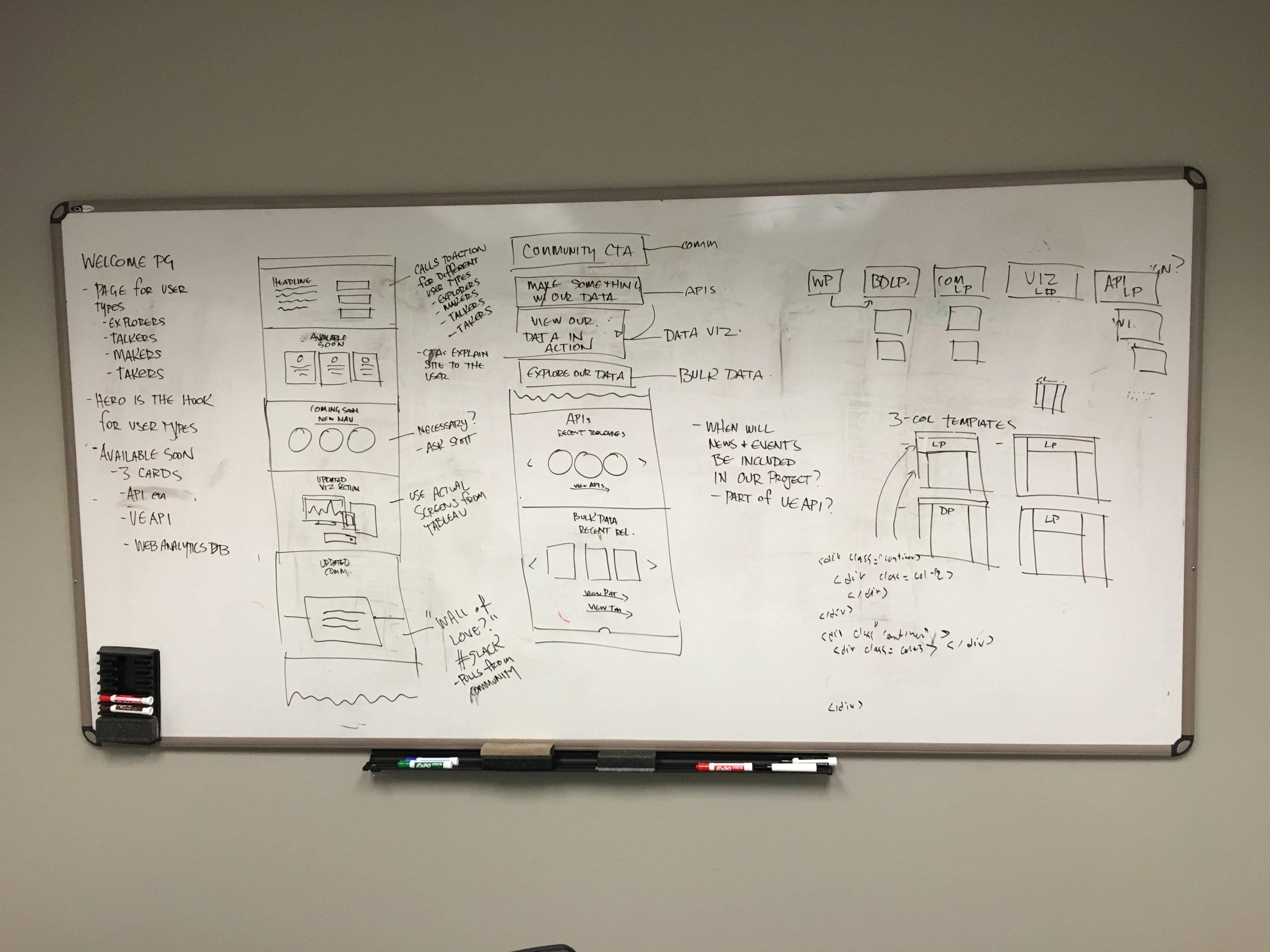
Whiteboard from a JAD session for the home page.
Once development started, the stakeholders and I met weekly to discuss concepts and direction so we could quickly move to design. This allowed us to refine the design several Sprints ahead of development
Open Data Portal site map.
The site map was our "secret sauce" for PI planning. We used it as the framework for planning each PI and breaking down the Product Backlog for the dev team.
Final visual design for the home page.
Design was able to stay several Sprints ahead of development for the entire project, allowing us to deliver and release the Open Data Portal two months ahead of time.
What the vision earned.
Nearly a decade after the platform I helped envision first shipped, its structure is still recognizable in the system USPTO runs today – absorbed, by the agency's own description, into the Open Data Portal that eventually replaced it. That kind of staying power isn't an accident on a federal timeline; it's what happens when a vision gets built with the people who have to live with it, defended in the room meeting after meeting, and held to even when nothing in the market was forcing the issue.
The clearest proof of that isn't always a metric. Sometimes it's a personal letter from the agency director, thanking you for helping them meet a federal mandate that will outlast your time there.
A personal thank-you letter from Michelle Lee, then-Director of USPTO.